
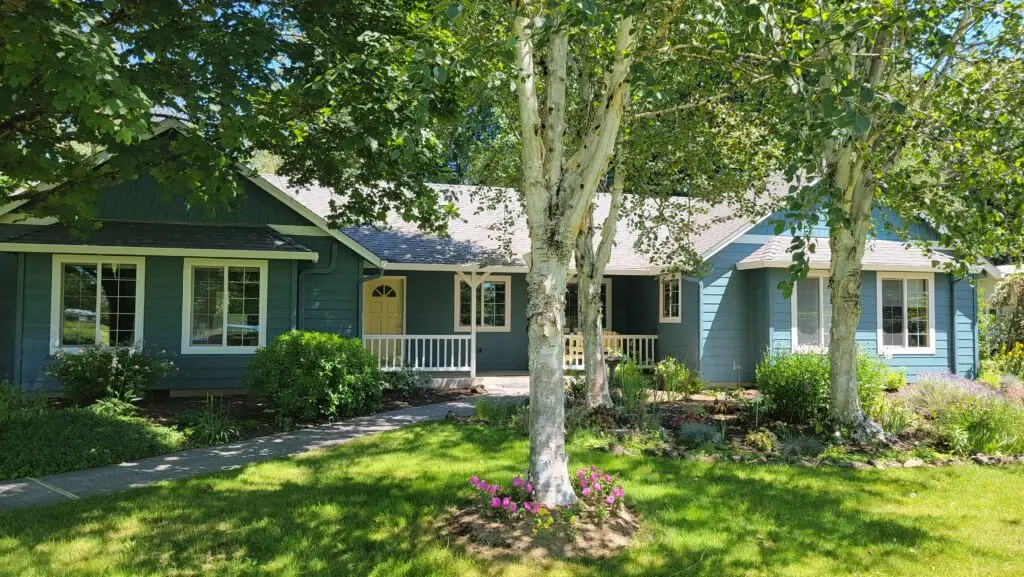
Search “siding replacement cost” and you get national averages built from data across forty-eight states. Those numbers are not useless, but they are not what you will pay in Clark County either. So here is what we actually charge, why it is structured the way it is, and what should make you suspicious of a bid that comes in well under it.
Siding Replacement Cost in 2026: The Short Answer
We price siding by the square. One square is 100 square feet of wall.
- About $900 per square installed — labor and material.
- Add about $300 per square if the existing siding has to come off first, which covers tear-off and disposal.
- A typical two-story runs about 20 squares, which works out to roughly $24,000 torn off and replaced.
Most houses we side fall between 15 and 25 squares. At our rate, that puts a full tear-off and replacement somewhere between $18,000 and $30,000 for most homes, or roughly $13,500 to $22,500 if the existing siding can stay and the new material goes over it.
If you prefer thinking in square feet, $900 per square is $9 per square foot installed, or about $12 per square foot with tear-off included.
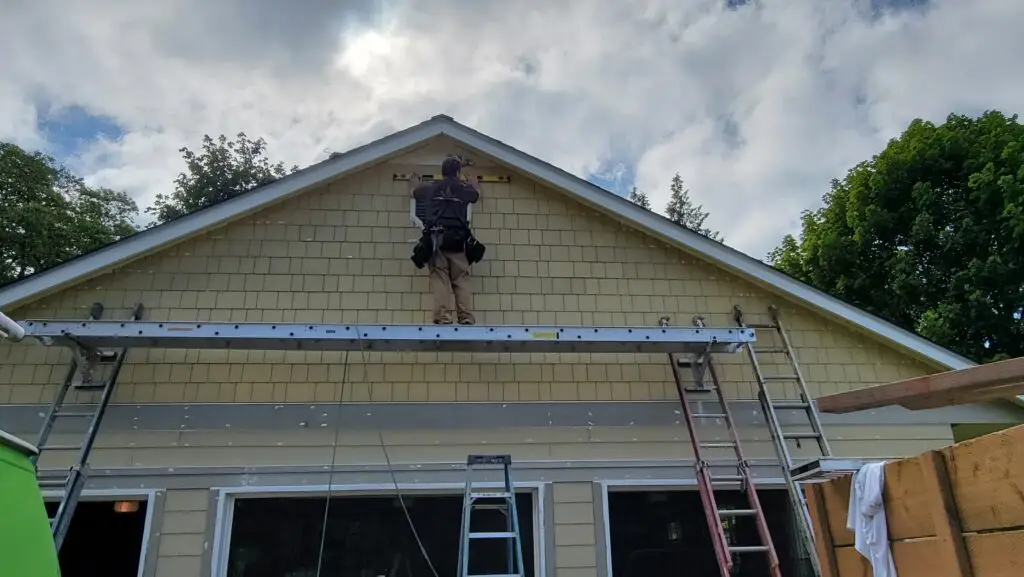
What a “Square” Is, and How to Estimate Yours
A square is just 100 square feet of wall surface. Contractors use it because siding is manufactured and sold that way, and because it is a far more honest unit than the floor area of your house.
Two homes with identical 1,800 square foot floor plans can differ by five or six squares depending on whether one is a single-story rambler with a wide footprint and the other is a two-story with tall gable ends. Height, dormers, bump-outs and the number of gables all add wall area that never shows up in the listing.
You can rough it out yourself by multiplying the length of each exterior wall by its height and dividing the total by 100. That will get you in the neighborhood. We measure the actual elevations at the walk-through, because the difference between your estimate and the real number is usually two or three squares, and at $1,200 a square that is real money.
What That Price Includes — and What It Does Not
This is where bids diverge most, and it is the single most useful thing to check when you are comparing two numbers. Our per-square rate includes:
- House wrap
- Flashing
- Trim
- Corners
- Labor and material
- Disposal, when tear-off is part of the job
- Permit costs, on the jobs that need one
It does not include:
- Dry rot repair — priced separately, and explained below
- Painting — fiber cement can be ordered pre-finished or painted on site
- Gutters and roofing — related work, separate line items
- Window or door replacement, if you are doing that at the same time
A bid that quotes a lower per-square number and then adds house wrap, flashing and trim as extras is not actually cheaper. It just moves the money.
Why We Only Install Fiber Cement
We install fiber cement lap — HardiePlank — and nothing else. That is a deliberate narrowing rather than a limitation.
Southwest Washington puts exterior material through a hard cycle: months of steady wet, then a summer that dries everything out fast. Fiber cement does not move much with that swing. It does not split or check, and it holds paint significantly longer than wood-based products, which is what most people are actually paying for over a fifteen-year horizon.
Standardizing on one product also means it gets installed the same way every time, by people who have hung a great deal of it. There is no learning curve on your house.
Dry Rot: The Number Nobody Can Quote Up Front
Dry rot is the single largest variable in an exterior project, and it is the one no honest contractor can price before opening a wall.
We bill rot repair time and materials. We open the suspect areas, look at what is actually there, evaluate it with you, and give you a price for the repair before we do the work. Then you decide.
If a contractor hands you a firm rot number sight unseen, one of two things is happening. Either they have padded it heavily to protect themselves, in which case you are paying for damage you may not have, or they have not accounted for it at all and you will meet it later as a change order. Neither is better than being told the truth up front.
The tells that you probably have some: bubbling paint, dark staining, siding that has cupped or pulled away from the wall, and trim at the base of windows that gives when you press a screwdriver into it.
What Exterior Painting Costs on Its Own
Plenty of homeowners do not need new siding at all — they need the house painted. On a typical two-story, exterior painting on its own runs $6,000 to $10,000.
Where you land inside that range comes down to detail rather than square footage: how many colors, whether the gutters get painted, how many doors, and how much trim there is to cut in. A two-color scheme on a plain elevation is a different job from a three-color scheme on a house with heavy trim, and the labor is where the difference shows.
Prep is most of the work regardless. Wash, scrape, prime bare wood, caulk the joints. Paint applied over dirt or unprimed wood peels within two winters no matter what the can cost.
Siding Replacement Cost in Camas, Washougal & Vancouver
Local conditions move these numbers in ways a national average will not capture. Older homes around Camas and Washougal were built in batches, and each batch has its own habits — the seventies places tend to have the ground-contact problems, the nineties subdivisions tend to have the flashing shortcuts.
Access matters more here than in flatter parts of the country. A two-story on a steep lot needs staging that a rambler on level ground does not, and that is labor before a single board goes on.
And our winters are the reason dry rot is a first-order concern rather than an afterthought. Seven months of wet finds every unsealed joint. By the time you can see a problem from the driveway, it has usually been working on the sheathing for a while.
How to Compare Two Siding Bids
If you get more than one estimate — and you should — these are the four questions that make them comparable:
- Is house wrap, flashing, trim and corners included in the per-square price, or listed separately further down?
- Is disposal included in the tear-off number?
- How is dry rot handled? A firm number sight unseen is a warning sign. So is no mention of it at all.
- Is the bid per square or a lump sum? A lump sum with no wall measurement behind it is a guess wearing a suit.
Also worth thirty seconds: run any contractor’s UBI number through Washington L&I’s contractor lookup. It tells you whether they are registered, bonded and paid up. Ours is #603-267-042.
Frequently Asked Questions
Can I just replace the bad sections instead of the whole house?
Sometimes, and we will tell you when that is the sensible call. The catch is matching: existing siding has weathered and been painted, and a patch rarely disappears completely. On an elevation that faces the street, most people end up preferring a full wall. On a side elevation nobody sees, a repair is often the right answer.
How long does a siding job take?
A straightforward tear-off and replacement on an average house runs one to two weeks on site. Rot repair adds days depending on what turns up. Paint is scheduled separately, because it needs dry weather and the right temperatures.
What time of year can siding be done?
Siding and repairs go on year round in Clark County. Painting is weather dependent, which realistically means late spring through early fall. Booking the repair and siding work over the winter and the paint for summer is a common and sensible sequence.
Do I need a permit to replace siding?
No. Installing siding does not require a permit. And on the jobs where a permit is needed for something else we run into, that cost is already built into the price we quote you — it does not come back later as an extra line.
How do I get an accurate siding replacement cost for my house?
We walk the house, measure the actual elevations, probe anything soft, and give you a written scope and price with the allowances spelled out. It is free and there is no follow-up campaign afterward.
The Honest Version
Siding is one of the few remodeling projects where the cheapest bid is reliably the most expensive one. The savings almost always come from somewhere real — house wrap left out, flashing reused, rot painted over, trim quoted as an extra later. None of that shows on the day the job finishes. All of it shows in about four years.
If you want a straight number for your house, see how we handle siding and exterior work or ask for a free walk-through. We are based in Camas and work across Washougal, Vancouver, Battle Ground, Ridgefield and the rest of Clark County.